
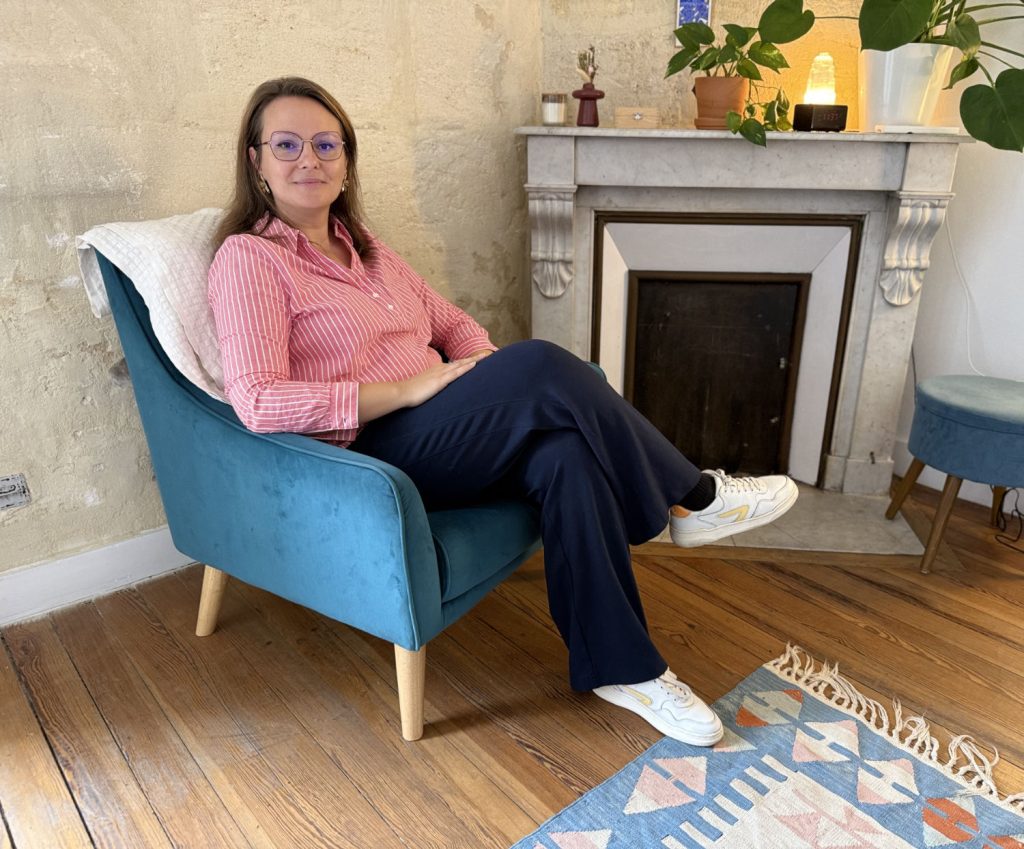
A journey shaped by listening to and understanding others.
After spending around ten years working in higher education, notably as an educational advisor at KEDGE Business School and Sciences Po Bordeaux, I decided to embark on a new career path to become a clinical psychologist.
Over the years, I have supported many students and young adults as they navigated their personal journeys, paying close attention to the challenges they faced, whether related to adapting to a new environment, relationships with others, periods of transition, or painful life events. These experiences have deepened my interest in understanding individual life journeys and the psychological processes at play during times of vulnerability.
Gradually, I felt the desire to explore this aspect of care more deeply and to focus more specifically on the psychological dimension. I therefore pursued a Bachelor’s degree in Psychology at Jean Jaurès University in Toulouse, followed by a Master’s degree in Clinical Psychoanalytic Psychopathology at Sorbonne Paris Nord University, specialising in Intercultural and Transcultural Clinical Psychology.
This training marked an important step in my personal and professional journey. It allowed me to deepen my understanding of psychological suffering, as well as how personal experiences, family relationships, and the environment in which a person grows up contribute to shaping their identity and the way they experience and relate to the world.
A psychoanalytic approach, attentive to each person’s unique life story.
My clinical approach is informed by psychoanalytic theory and is based on the understanding that the difficulties we encounter throughout life cannot always be fully understood through their visible manifestations alone. They may also become more meaningful when considered in the light of our personal history, lived experiences, emotional relationships, and the sometimes unconscious conflicts that shape our inner lives.
Therapy provides a space where thoughts and feelings can be freely expressed, where difficulties can gradually be put into words, and where new ways of understanding can emerge.
It’s not about offering ready-made answers, but about taking the time to explore the sources of suffering, while respecting each person’s uniqueness and individual pace.
Some silences or roles within a family may be shaped by experiences and events that predate our own personal history. Previous generations can leave traces in family narratives, but also in what could not be spoken about or emotionally processed.
Exploring these connections can help us better understand recurring patterns, relationship difficulties, or questions about identity, without implying that our family history determines who we become.
Intercultural and Transcultural Clinical Practice: Understanding the Individual in Their Environment
My training in intercultural and transcultural clinical psychology has made me particularly aware of the importance of culture, cultural identity, and social and family environments in understanding psychological life.
This approach is sometimes associated exclusively with migrants or families from different cultural backgrounds. However, it is not limited to these situations. More broadly, it encourages us to consider each person within the context of their life, taking into account the cultural influences that shape them, their upbringing, family history, social background, language, sense of belonging, and the values that have contributed to who they are today.
We never develop independently of our environment. It shapes the way we perceive the world, understand our emotions, form relationships, and make sense of our experiences.
The transcultural approach therefore encourages us not to view psychological difficulties in isolation, but to understand them within the broader network of relationships and contexts that shape an individual’s life story. It allows us to remain attentive to what is shared in the human experience, while recognising what makes each person’s journey unique.
My Experience in Clinical Psychology
During my training, I had the opportunity to gain experience in a variety of clinical settings and explore different therapeutic approaches, working with children, adolescents, families, and individuals facing vulnerable circumstances.
My professional experience has included working in a variety of settings:
- Working with unaccompanied minors at the Institut Don Bosco, where I gained insight into the psychological challenges associated with migration experiences, separation, major life disruptions, and identity development.
- In the transcultural consultation service at Bordeaux University Hospital, where I was able to deepen my understanding of the connections between psychological experiences, cultural backgrounds, and family histories, particularly through my work with pregnant women from migrant backgrounds.
- At the GHU Paris Child and Adolescent Mental Health Centre (CMP Grande Enfance), where I gained my first experience in clinical work with children and their families, and developed an understanding of the importance of exploring children’s psychological functioning within the context of their relationships and environment.
- Through my experience in psychiatric and institutional settings, I had the opportunity to take part in clinical observations, interviews, and psychological assessments, while discovering the value and richness of multidisciplinary collaboration.
These experiences have helped shape my clinical practice and deepen my interest in the connections between personal history, family relationships, the environment, and inner psychological life.